Youth Risk Behavior Surveillance

Aim:to analyse the health patterns of American high scholers (9th through 12th grade) using R libraries.
Data: Every two years, the Centers for Disease Control and Prevention conduct the Youth Risk Behavior Surveillance System (YRBSS) survey, where it takes data from high schoolers (9th through 12th grade), to analyze health patterns.
Loading the data
This data is part of the openintro textbook and we can load and inspect it.
?yrbss
data(yrbss)
glimpse(yrbss)
## Rows: 13,583
## Columns: 13
## $ age <int> 14, 14, 15, 15, 15, 15, 15, 14, 15, 15, 15, 1…
## $ gender <chr> "female", "female", "female", "female", "fema…
## $ grade <chr> "9", "9", "9", "9", "9", "9", "9", "9", "9", …
## $ hispanic <chr> "not", "not", "hispanic", "not", "not", "not"…
## $ race <chr> "Black or African American", "Black or Africa…
## $ height <dbl> NA, NA, 1.73, 1.60, 1.50, 1.57, 1.65, 1.88, 1…
## $ weight <dbl> NA, NA, 84.37, 55.79, 46.72, 67.13, 131.54, 7…
## $ helmet_12m <chr> "never", "never", "never", "never", "did not …
## $ text_while_driving_30d <chr> "0", NA, "30", "0", "did not drive", "did not…
## $ physically_active_7d <int> 4, 2, 7, 0, 2, 1, 4, 4, 5, 0, 0, 0, 4, 7, 7, …
## $ hours_tv_per_school_day <chr> "5+", "5+", "5+", "2", "3", "5+", "5+", "5+",…
## $ strength_training_7d <int> 0, 0, 0, 0, 1, 0, 2, 0, 3, 0, 3, 0, 0, 7, 7, …
## $ school_night_hours_sleep <chr> "8", "6", "<5", "6", "9", "8", "9", "6", "<5"…yrbss %>% mutate(race = factor(race))## # A tibble: 13,583 × 13
## age gender grade hispanic race height weight helmet_12m text_while_driv…
## <int> <chr> <chr> <chr> <fct> <dbl> <dbl> <chr> <chr>
## 1 14 female 9 not Black … NA NA never 0
## 2 14 female 9 not Black … NA NA never <NA>
## 3 15 female 9 hispanic Native… 1.73 84.4 never 30
## 4 15 female 9 not Black … 1.6 55.8 never 0
## 5 15 female 9 not Black … 1.5 46.7 did not r… did not drive
## 6 15 female 9 not Black … 1.57 67.1 did not r… did not drive
## 7 15 female 9 not Black … 1.65 132. did not r… <NA>
## 8 14 male 9 not Black … 1.88 71.2 never <NA>
## 9 15 male 9 not Black … 1.75 63.5 never <NA>
## 10 15 male 10 not Black … 1.37 97.1 did not r… <NA>
## # … with 13,573 more rows, and 4 more variables: physically_active_7d <int>,
## # hours_tv_per_school_day <chr>, strength_training_7d <int>,
## # school_night_hours_sleep <chr>skimr::skim(yrbss) #to get a feel about the dataset| Name | yrbss |
| Number of rows | 13583 |
| Number of columns | 13 |
| _______________________ | |
| Column type frequency: | |
| character | 8 |
| numeric | 5 |
| ________________________ | |
| Group variables | None |
Variable type: character
| skim_variable | n_missing | complete_rate | min | max | empty | n_unique | whitespace |
|---|---|---|---|---|---|---|---|
| gender | 12 | 1.00 | 4 | 6 | 0 | 2 | 0 |
| grade | 79 | 0.99 | 1 | 5 | 0 | 5 | 0 |
| hispanic | 231 | 0.98 | 3 | 8 | 0 | 2 | 0 |
| race | 2805 | 0.79 | 5 | 41 | 0 | 5 | 0 |
| helmet_12m | 311 | 0.98 | 5 | 12 | 0 | 6 | 0 |
| text_while_driving_30d | 918 | 0.93 | 1 | 13 | 0 | 8 | 0 |
| hours_tv_per_school_day | 338 | 0.98 | 1 | 12 | 0 | 7 | 0 |
| school_night_hours_sleep | 1248 | 0.91 | 1 | 3 | 0 | 7 | 0 |
Variable type: numeric
| skim_variable | n_missing | complete_rate | mean | sd | p0 | p25 | p50 | p75 | p100 | hist |
|---|---|---|---|---|---|---|---|---|---|---|
| age | 77 | 0.99 | 16.16 | 1.26 | 12.00 | 15.00 | 16.00 | 17.00 | 18.00 | ▁▂▅▅▇ |
| height | 1004 | 0.93 | 1.69 | 0.10 | 1.27 | 1.60 | 1.68 | 1.78 | 2.11 | ▁▅▇▃▁ |
| weight | 1004 | 0.93 | 67.91 | 16.90 | 29.94 | 56.25 | 64.41 | 76.20 | 180.99 | ▆▇▂▁▁ |
| physically_active_7d | 273 | 0.98 | 3.90 | 2.56 | 0.00 | 2.00 | 4.00 | 7.00 | 7.00 | ▆▂▅▃▇ |
| strength_training_7d | 1176 | 0.91 | 2.95 | 2.58 | 0.00 | 0.00 | 3.00 | 5.00 | 7.00 | ▇▂▅▂▅ |
Exploratory Data Analysis
Starting out by analyzing the weight of participants in kilograms.
#number of missing values in the 'weight' column:
sumna <- sum(is.na(yrbss['weight']))
print(paste0("there are " , sumna ," missing values." ))
## [1] "there are 1004 missing values."#using mosaic's favstats
favstats(~weight, data=yrbss)## min Q1 median Q3 max mean sd n missing
## 29.94 56.25 64.41 76.2 180.99 67.9065 16.89821 12579 1004#as it is also apparent in the favstat's function output, there are 1004 missing values in the weight column.
#histogram of the weight distribution
ggplot(yrbss, aes(x=weight))+
geom_histogram(bindwidth=5, color ="black", fill = "white")+
labs (title = "Histogram of Weigth Distribution",
y = "Count",
x = "Weight (in kilograms)")+
theme_bw()+
geom_vline(aes(xintercept = mean(weight, na.rm = TRUE)), color="blue", linetype="dashed", size=1)+
NULL## Warning: Ignoring unknown parameters: bindwidth## `stat_bin()` using `bins = 30`. Pick better value with `binwidth`.## Warning: Removed 1004 rows containing non-finite values (stat_bin).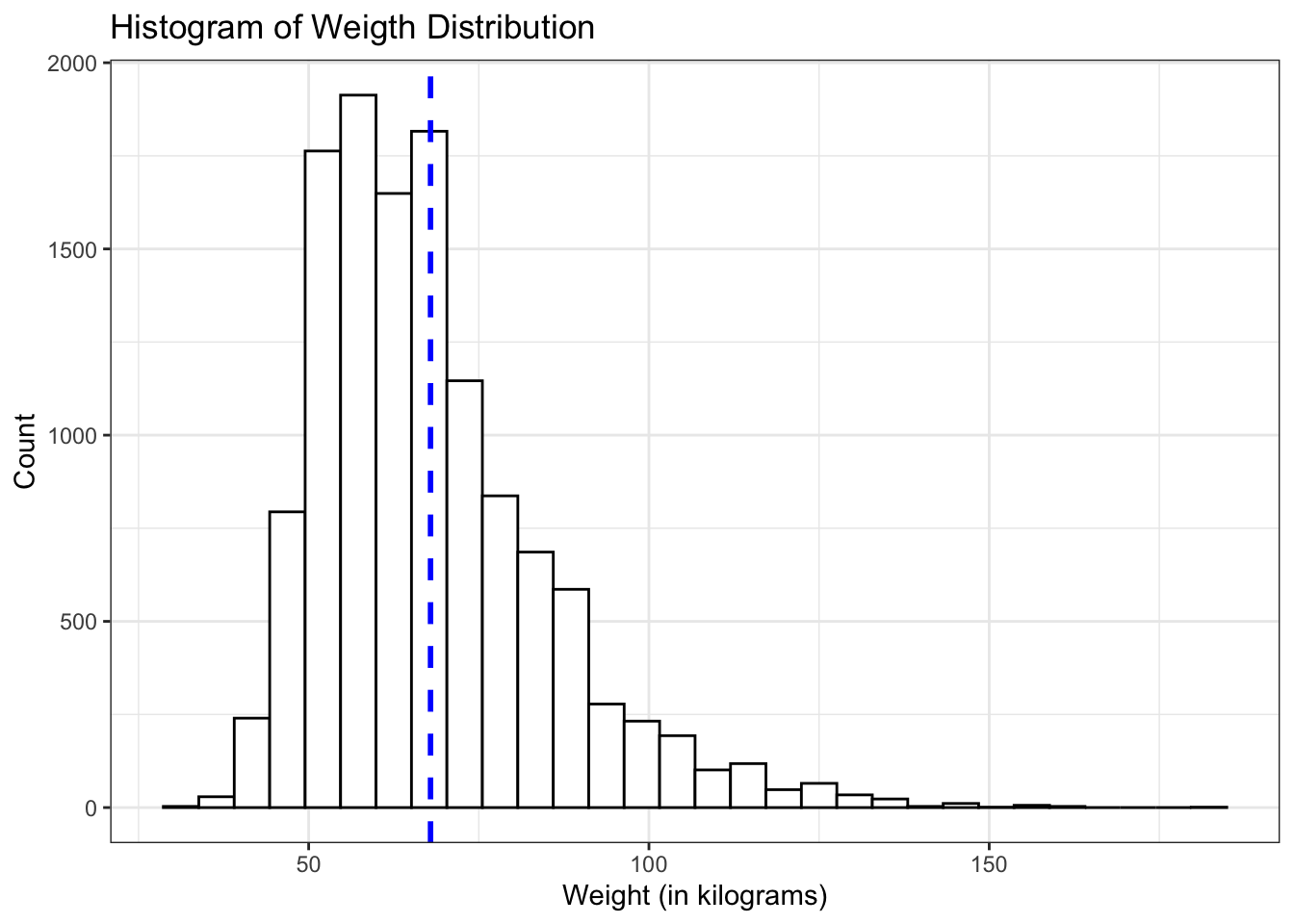
#density plot of the weight distribution
  ggplot(yrbss, aes(x=weight)) +
  geom_density() +
  labs (title = "Density Plot of Weight Distribution",
        x = "Weight (in kilograms)")+
  theme_bw()+
  NULL
## Warning: Removed 1004 rows containing non-finite values (stat_density).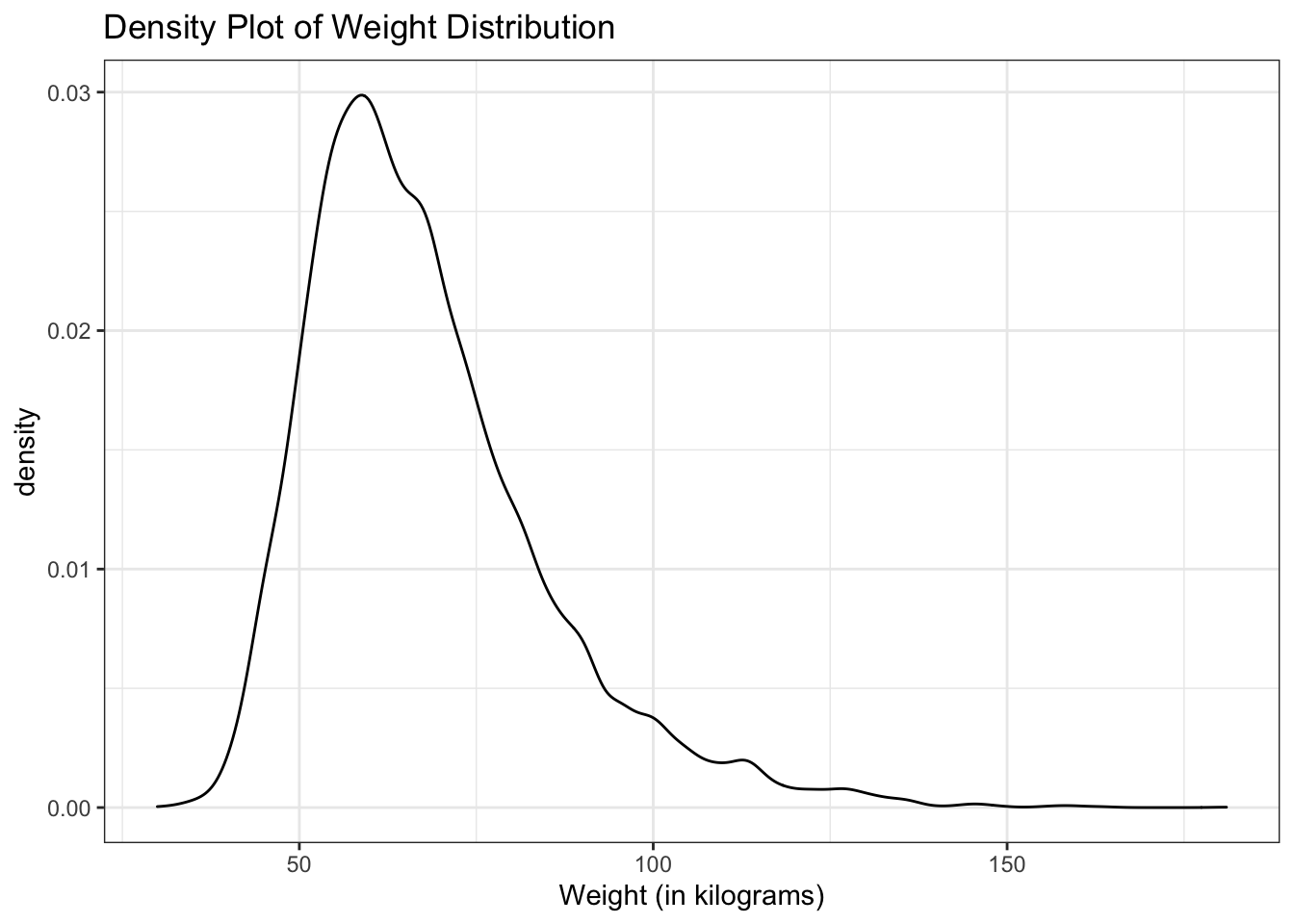
Is there a relationship between a high schooler’s weight and their physical activity? By adding a new column that shows whether a student exercised more than 3 days a week or not, the relationship with exercises and non-exercises can be easily determined.
yrbss %>%
  filter(!is.na(physically_active_7d))%>%
  ggplot(aes(x = factor(physically_active_7d))) +
  geom_boxplot(aes(y=weight))+
  labs (title = "Distribution of Weight by Number of Active days in a week",
        x = "Number of Active Days in a Week",
        y = "weight (kg)") +
  theme_bw()
## Warning: Removed 946 rows containing non-finite values (stat_boxplot).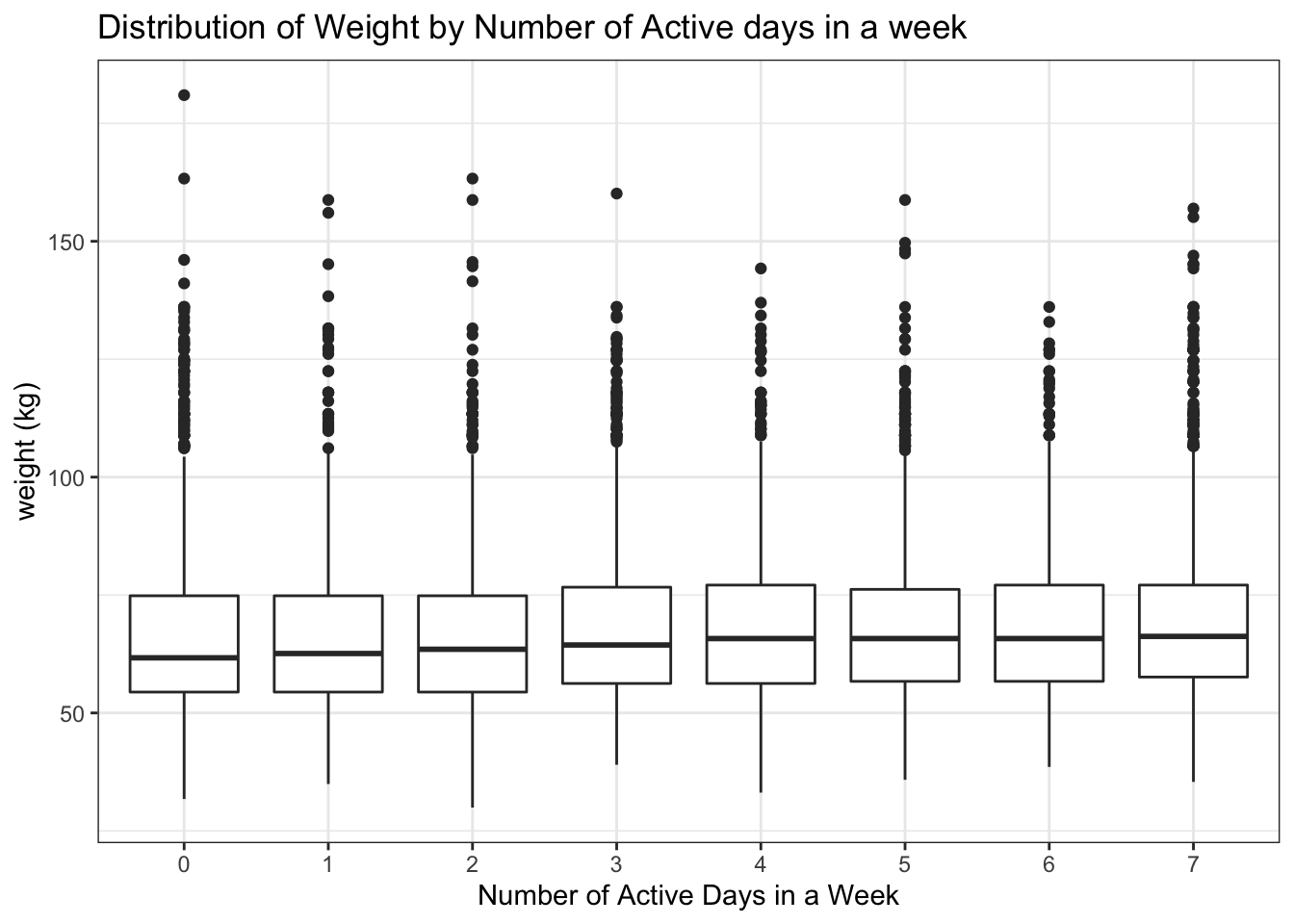
  #adding the new variable `physical_3plus` that shows if a student is physically active 3 or more days a week.
  physical <- yrbss %>%
    mutate(physical_3plus = case_when(physically_active_7d >= 3 ~ "yes",
                                       physically_active_7d < 3 ~ "no"),
          physical_3plus = factor(physical_3plus, levels = c("yes", "no")))

 count_physical <- physical %>%
   filter(!is.na(physical_3plus)) %>%
   count(physical_3plus) %>%
   mutate(prop = n/sum(n))

 #5685, 2656

 prop.test(count_physical$n[2]  , count_physical$n[2] + count_physical$n[1])
##
## 1-sample proportions test with continuity correction
##
## data: [ out of +count_physical$n out of count_physical$n[2]2 out of count_physical$n[1]
## X-squared = 1522.1, df = 1, p-value < 2.2e-16
## alternative hypothesis: true p is not equal to 0.5
## 95 percent confidence interval:
## 0.3228978 0.3389583
## sample estimates:
## p
## 0.33087995% confidence interval for the population proportion of high schools that are NOT active 3 or more days per week?
The 95 percent confidence interval according to the prop.test function is from 0.3228978 to 0.3389583.
data: [ out of +count_physical\(n out of count_physical\)n[2]2 out of count_physical$n[1] X-squared = 1522, df = 1, p-value <2e-16 alternative hypothesis: true p is not equal to 0.5 95 percent confidence interval: 0.323 0.339 sample estimates: p 0.331
Initial plotting of the data doesn’t suggest a strong correlation between weekly physical activity levels and weight.
A boxplot of physical_3plus vs. weight. Is there a relationship between these two variables?
#removing rows that contain NAs from the physical table...
   physical <- physical %>%
   filter(!is.na(physical_3plus) & !is.na(weight))

#box plot of physical_3plus vs weight:

  ggplot(physical, aes(x=physical_3plus, y = weight)) +
  geom_boxplot()+
  labs (title = "Distribution of Weight, Based on weekly activity level",
        x = "Working out 3 or more days: Yes or No",
        y = "weight (kg)") +
  theme_bw()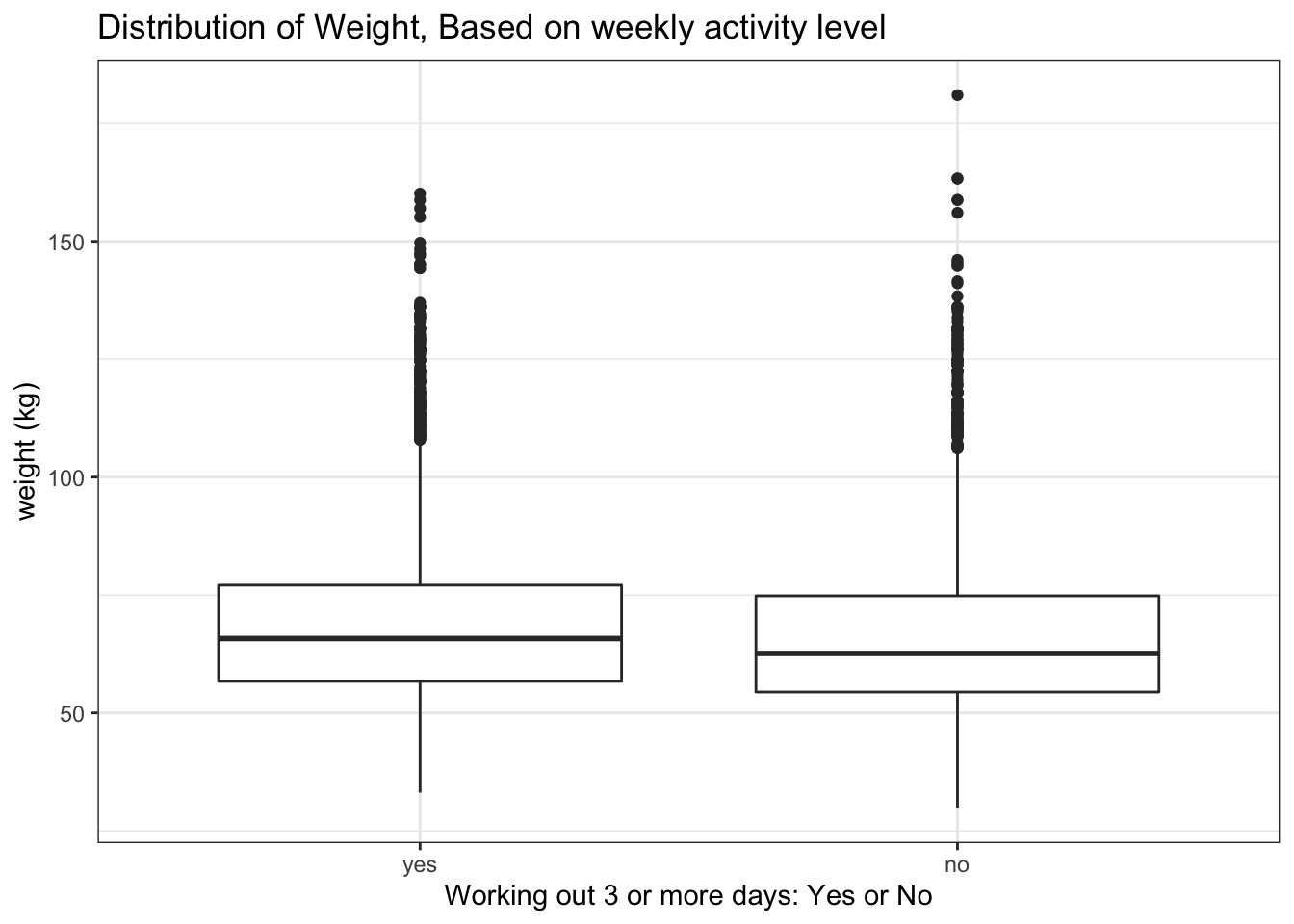
People who work out 3 days a week or more are slightly heavier on average. One might expect the opposite, but weight is not a great indicator of fitness levels as it varries widely with height, and the number of workout days might not indicate the intensity of the workouts either. We would expect a stronger negative correlation between bodyfat percentage and number of active days a week.
Confidence Interval
Boxplots show how the medians of the two distributions compare, but we can also compare the means of the distributions using either a confidence interval or a hypothesis test. Note that when we calculate the mean, SD, etc. weight in these groups using the mean function, we must ignore any missing values by setting the na.rm = TRUE.
set.seed(1234)
#calculating CI using formulas:

#physical_3plus == "yes
 yes_result<- physical %>%
   filter(physical_3plus == "yes") %>%
   summarise( yes_mean = mean(weight, na.rm = TRUE),
              yes_n = count(physical_3plus == "yes"),
              yes_sd = sd(weight, na.rm = TRUE),
              t_critical = qt(0.975, yes_n -1),
              se_yes = yes_sd / sqrt(yes_n),
              margin_of_error = t_critical * se_yes,
              yes_low_CI= yes_mean - margin_of_error,
              yes_high_CI= yes_mean + margin_of_error
              )

print(paste0("the confidence interval is ",  as.numeric(yes_result['yes_low_CI']), " - ", as.numeric(yes_result['yes_high_CI']) ))
## [1] "the confidence interval is 68.094807893518 - 68.8021328880692"#we can get a very similar result using the bootstrap approach for confidence intervals by infer package:
boot_dist1 <- physical %>%
filter(physical_3plus == "yes") %>%
specify(response = weight) %>%
# Generate bootstrap samples
generate(reps = 1000, type = "bootstrap") %>%
# Calculate mean of each bootstrap sample
calculate(stat = "mean")
boot_dist1## Response: weight (numeric)
## # A tibble: 1,000 × 2
## replicate stat
## <int> <dbl>
## 1 1 68.2
## 2 2 68.3
## 3 3 68.4
## 4 4 68.4
## 5 5 68.8
## 6 6 68.0
## 7 7 68.5
## 8 8 68.4
## 9 9 68.6
## 10 10 68.6
## # … with 990 more rowspercentile_ci1 <- get_ci(boot_dist1, level = 0.95, type ="percentile")
#visualisation of the resulting bootstrap distribution and the CIs
visualize(boot_dist1) +
shade_ci(endpoints=percentile_ci1, fill="khaki") +
geom_vline(xintercept = yes_result$yes_low_CI, colour ="red") +
geom_vline(xintercept = yes_result$yes_high_CI, colour = "red") +
NULL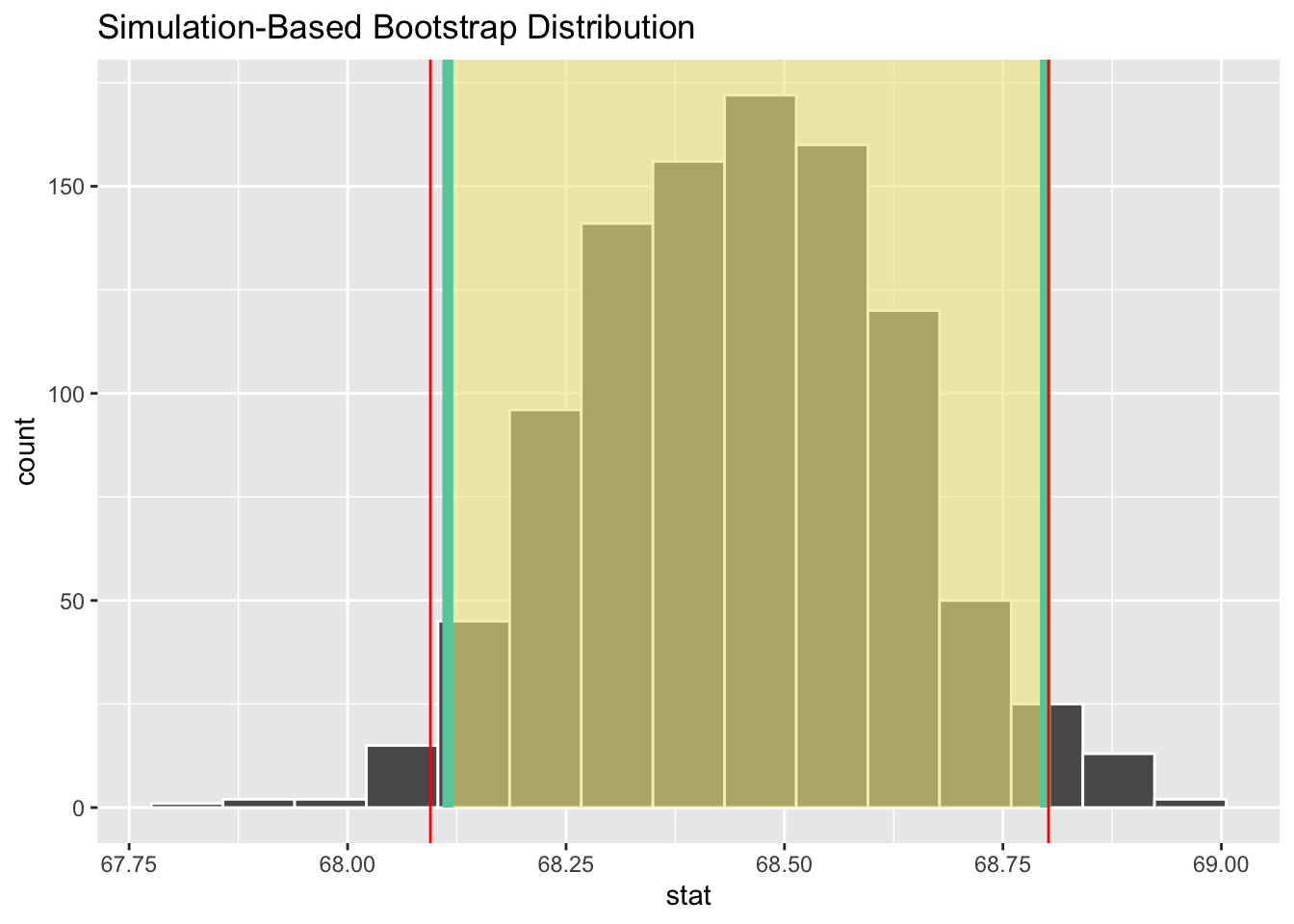
#physical_3plus == "no"
no_result <-physical %>%
   filter(!is.na(physical_3plus)) %>%
   filter(physical_3plus == "no") %>%
   summarise( no_mean = mean(weight, na.rm = TRUE),
              no_n = count(physical_3plus == "no"),
              no_sd = sd(weight, na.rm = TRUE),
              t_critical = qt(0.975, no_n -1),
              se_no= no_sd / sqrt(no_n),
              margin_of_error = t_critical * se_no,
              no_low_CI= no_mean - margin_of_error,
              no_high_CI= no_mean + margin_of_error)

print(paste0("the confidence interval is ",  as.numeric(no_result['no_low_CI']), " - ", as.numeric(no_result['no_high_CI']) ))
## [1] "the confidence interval is 66.1286201312585 - 67.2191521213521"#we can also get a very similar result using the bootstrap approach for confidence intervals by infer package:
boot_dist2 <- physical %>%
filter(!is.na(physical_3plus)) %>%
filter(physical_3plus == "no") %>%
specify(response = weight) %>%
# Generate bootstrap samples
generate(reps = 1000, type = "bootstrap") %>%
# Calculate mean of each bootstrap sample
calculate(stat = "mean")
percentile_ci <- get_ci(boot_dist2, level = 0.95, type ="percentile")
#visualisation of the resulting bootstrap distribution and the CIs
visualize(boot_dist2) +
shade_ci(endpoints=percentile_ci, fill="khaki") +
geom_vline(xintercept = no_result$no_low_CI, colour ="red") +
geom_vline(xintercept = no_result$no_high_CI, colour = "red") +
labs(title="Simulation-Based Bootsrap Distribution for No Answers") +
NULL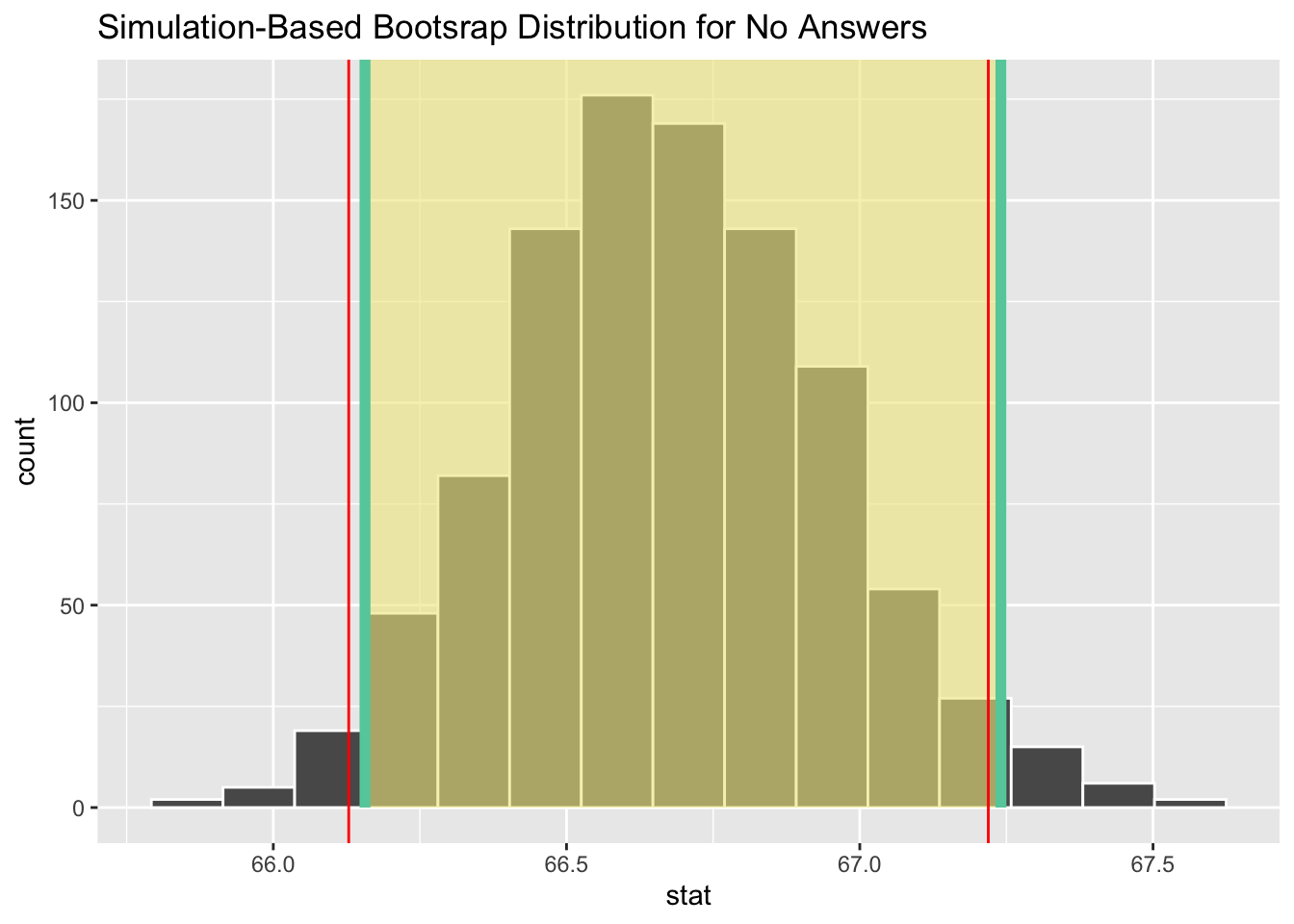
There is an observed difference of about 1.77kg (68.44 - 66.67), and we notice that the two confidence intervals do not overlap. It seems that the difference is at least 95% statistically significant. Let us also conduct a hypothesis test.
Hypothesis test with formula
Null and alternative hypothesis: H0 = there is no difference in the weight of those who exercise 3 times a week and more compared to those who do not. H1 = there is a difference in the weight of those who exercise 3 times a week and more and those who do not.
t.test(weight ~ physical_3plus, data = physical)##
## Welch Two Sample t-test
##
## data: weight by physical_3plus
## t = 5.353, df = 7478.8, p-value = 8.908e-08
## alternative hypothesis: true difference in means between group yes and group no is not equal to 0
## 95 percent confidence interval:
## 1.124728 2.424441
## sample estimates:
## mean in group yes mean in group no
## 68.44847 66.67389Since the T value is 5 we can reject the NULL hypothesis, which means that we statistically sufficient evidence to say that there is a difference in the mean weight of those who work out more than 3 days a week and those who don’t.
Hypothesis test with infer package
obs_diff <- physical %>%
  specify(weight ~ physical_3plus) %>%
  calculate(stat = "diff in means", order = c("yes", "no"))

obs_diff
## Response: weight (numeric)
## Explanatory: physical_3plus (factor)
## # A tibble: 1 × 1
## stat
## <dbl>
## 1 1.77Simulating the test on the null distribution, which we will save as null.
  null_dist <- physical %>%
  # specify variables
  specify(weight ~ physical_3plus) %>%

  # assume independence, i.e, there is no difference
  hypothesize(null = "independence") %>%

  # generate 1000 reps, of type "permute"
  generate(reps = 1000, type = "permute") %>%

  # calculate statistic of difference, namely "diff in means"
  calculate(stat = "diff in means", order = c("yes", "no"))
We can visualize this null distribution with the following code:
ggplot(data = null_dist, aes(x = stat)) +
  geom_histogram()
## `stat_bin()` using `bins = 30`. Pick better value with `binwidth`.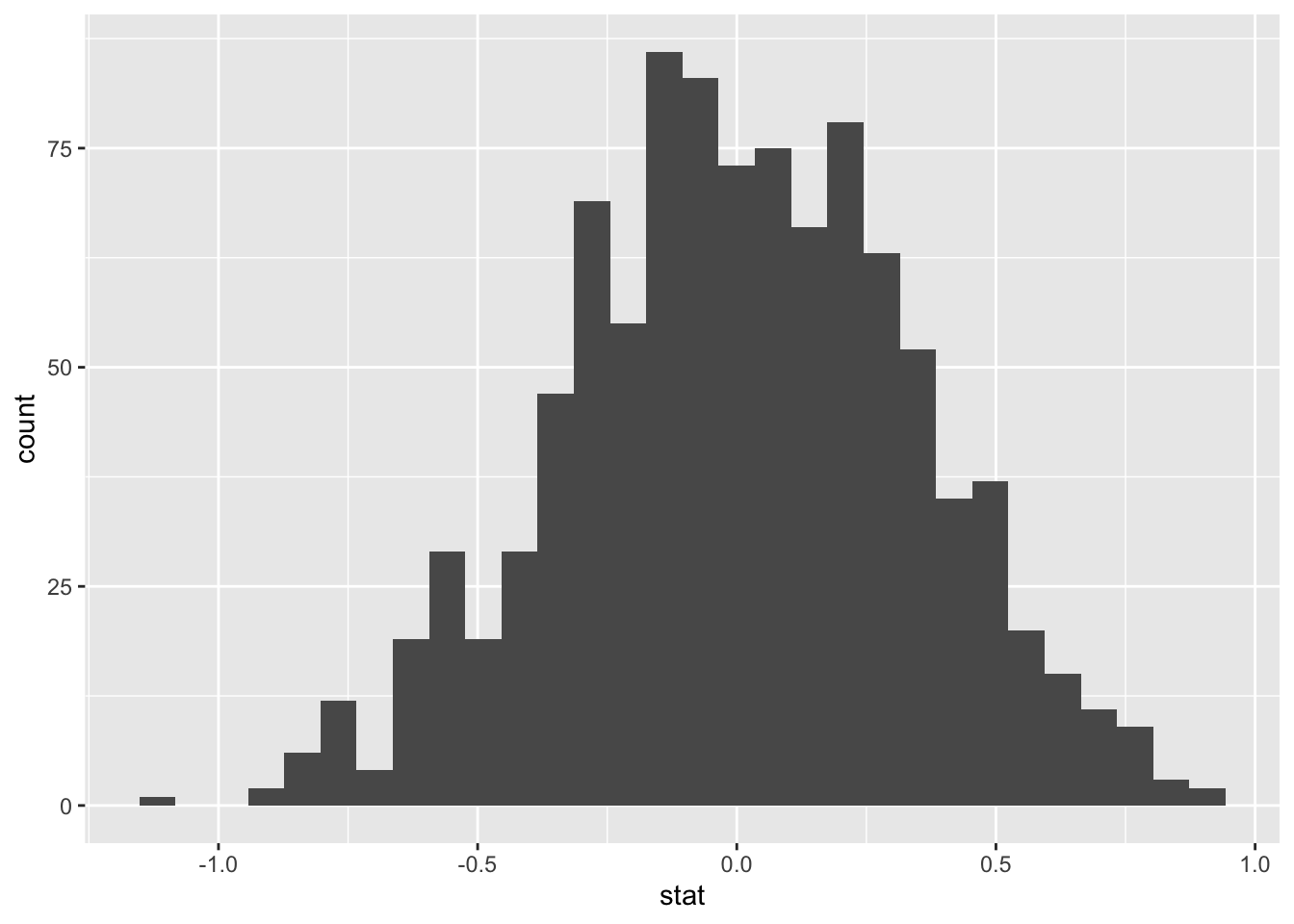
The p-value for your hypothesis test using the function infer::get_p_value().
null_dist %>% visualize() +
  shade_p_value(obs_stat = obs_diff, direction = "two-sided")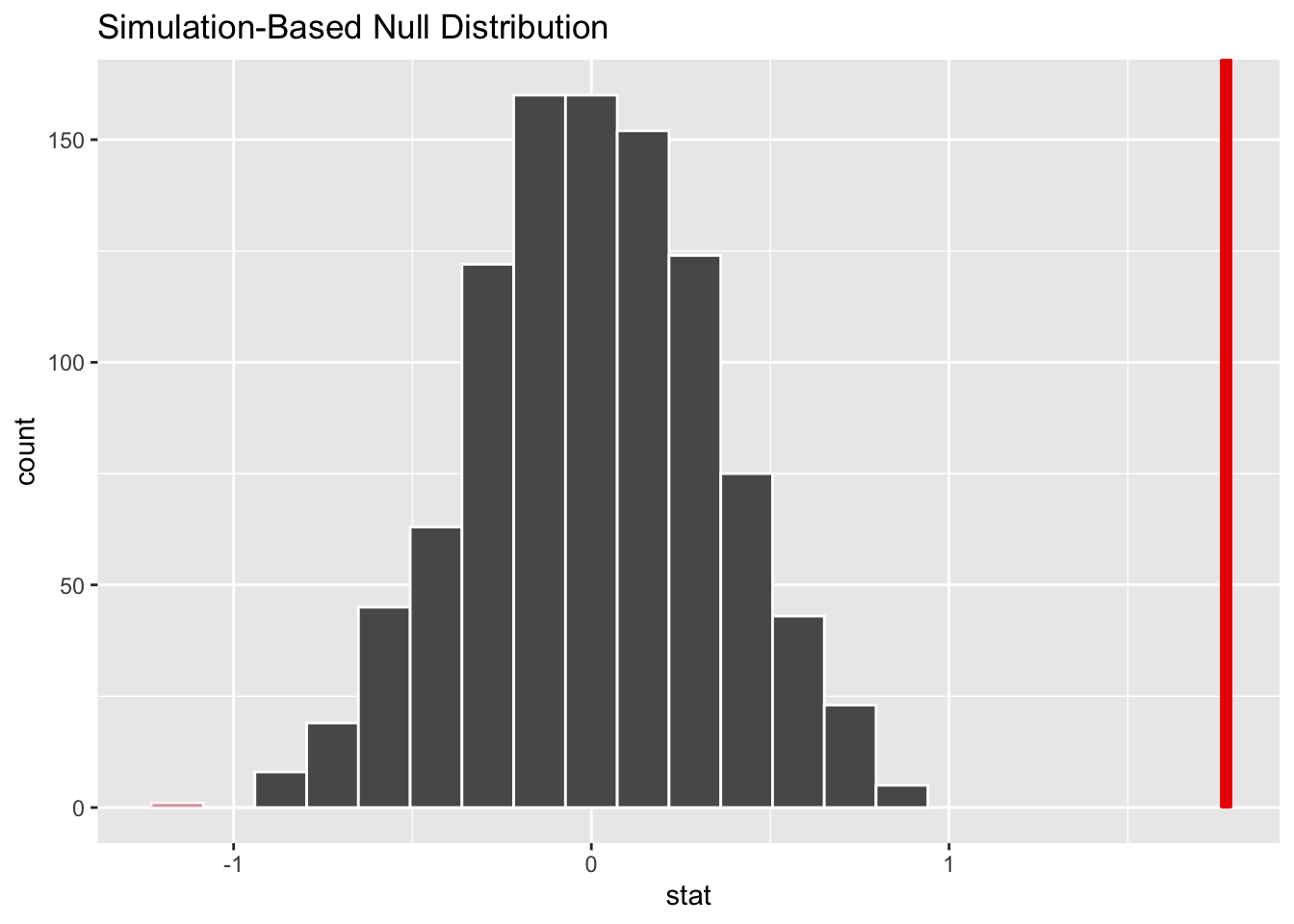
null_dist %>%
  get_p_value(obs_stat = obs_diff, direction = "two_sided")
## Warning: Please be cautious in reporting a p-value of 0. This result is an
## approximation based on the number of `reps` chosen in the `generate()` step. See
## `?get_p_value()` for more information.## # A tibble: 1 × 1
## p_value
## <dbl>
## 1 0Conclusion
Since p value is very small, we can reject the null hypothesis that there is no difference in the weight of those who exercise 3 times a week and more compaed to those who do not.